Airbnb’s Digital Business Model in the Sharing Economy
Have you heard of Airbnb?
Just kidding. Who hasn’t heard of Airbnb?
In fact, I must admit, when I go to book a holiday, Airbnb will be the first place I look for accommodation.
But how has it shot from zero to hero in the hospitality industry in the last decade?
What draws the attention of so many users and what makes it stand out from the typical chains in this industry?
How it all began…
Essentially, Airbnb is an accommodation booking engine that ‘connects people who have space to spare with those who are looking for a place to stay’ (Airbnb, 2020).
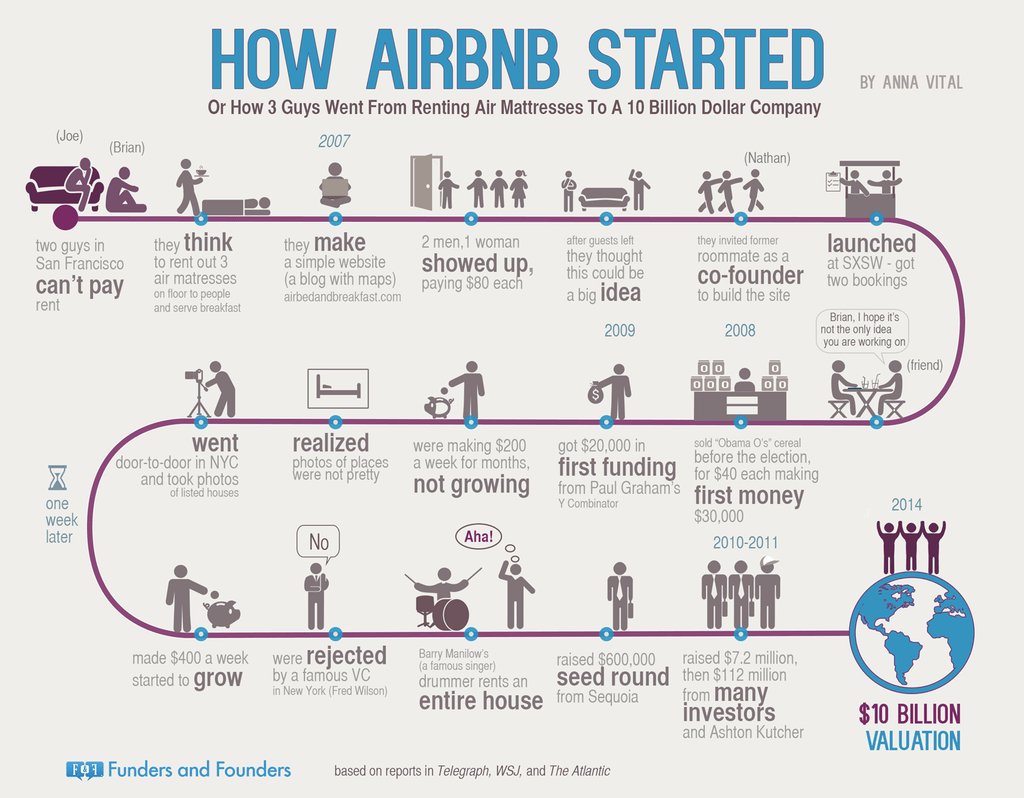
The company started in 2008 when three friends realised, they could make quick cash by renting out an air mattress in their San Francisco apartment. This simple idea evolved into a website that they coined ‘Air Mattress Bed and Breakfast’ (Al-Saad, 2019) offering travellers a cheaper alternative to a hotel stay.
One year in and they were stuck on just $200 a week. This is when they realised the pictures on their website just weren’t inviting. The three friends therefore went to every listing they had in New York and took photos of the accommodation. One week later they doubled their revenues to $400 a week and this exponential growth has never stopped! (Al-Saad, 2019).
Ten years, multiple investment injections and a name change (to simplified ‘Airbnb’) later and they now have 1.5 million properties in over 190 countries and an annual revenue of $3.6 billion (Craft, 2020).
Without a doubt, Airbnb is one of the most successful start ups of the century and their digital business model lies at the core of its success.
Let’s get digital…
Airbnb is made up of an entirely digital business model.
The company’s services are accessed solely through the mobile app and website. There are no booking agents or front desk receptionists to call.
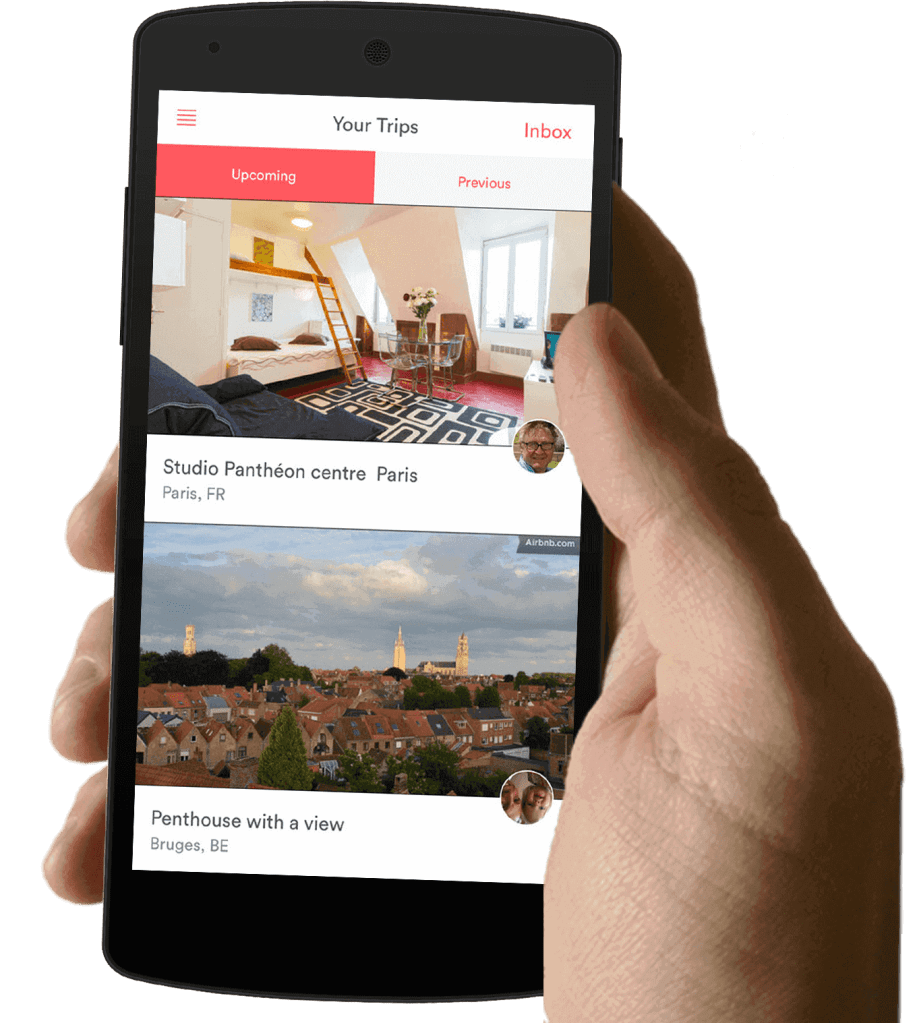
Users can browse, make reservations and manage accommodation listings all at the touch of a few buttons.
This digital platforms provides a marketplace connecting buyers and sellers in this industry.
But Airbnb is free to use so how do they make money?

Every booking on this app incurs a booking fee, and this charge goes straight into Airbnb’s pocket. Simple right!
Sharing is caring…
Unlike the typical ‘big players’ in this industry, Airbnb do not own a single piece of real estate – no hotel, no apartment – NOTHING!
Their digital model is built on the concept of the ‘Sharing Economy’, providing a platform enabling people to share their under used assets (Bocker & Meelen, 2017).
Why is their digital business model SO sucessful?
Disruptive Innovation
Airbnb’s entirely digital approach was new, exciting and certainly disruptive. The platform offers accommodation in ‘unique’ (Gallagher, 2017) locations, appealing to consumers wanting a local experience with a cheaper price tag. Innovation that the hotel industry just can’t keep up with.
Their entirely digital approach saves them money in owning real state. Take Thomas Cook as an example, their outdated business model of expensive to run, high-street agents was one of the reasons they went bust (Hancock, 2019). Airbnb will never face this risk.
Its as easy as ABC
The digital platform is simple, and simplicity is the key to success. When a user opens the app, they enter where they want to go and the dates they are interested in and VOILA – all available places appear. The simplistic design appeals to all generations; prioritising both ease and speed for a population who demand all questions answered at the click of a button.
Connected lives
People today have a desire for all aspects of their life to be interconnected (Dell Technologies, 2019). Airbnb encompass this mega-trend allowing users to have their entire accommodation and experience days itinerary on their phone in the pocket, accessible in just a few seconds.
A personal touch
Their use of analytics through complex algorithms allows their model to incorporate an element of personalisation. When a customer logs into their site, their homepage displays recommendations for their stays, making customers feel as if someone is caring for them, despite no humans being involved.
What is next for their digital model?
The latest feature is ‘Smart Pricing’ which uses big data analytics to help hosts determine a price based on market popularity, seasonality and listing popularity etc. This will help hosts keep prices competitive as demand in their area changes (Airbnb, 2020). This feature could drive more hosts to use Airbnb hence mean further sucess for this company.
Simplicity is the key to success
Airbnb’s digital sharing market for accommodation has revolutionised the hospitality industry.
Its digital business model is made up of complex models, yet the interface with users is extremely simplistic.
This simplicity makes it unique and ultimately allows the company to reach success levels that are unparalleled throughout the rest of the hospitality industry.
Disruptive. Innovative. Unique.
This is Airbnb.
References
Airbnb. (2020, March 03). What is Airbnb? Retrieved from Airbnb: https://www.airbnb.co.uk/how-it-works?af=43720035&c=.pi0.pk12837552276_254933407854_c_12026464216&sem_position=&sem_target=aud-414944083185:kwd-12026464216&location_of_interest=&location_physical=1006707&ghost=true&gclid=CjwKCAiAnfjyBRBxEiwA-EECLCTqn9V7TJ
Airbnb. (2020, Macrh 04). What is Smart about Smart Pricing. Retrieved from Airbnb: https://blog.atairbnb.com/smart-pricing/
Al-Saad, T. (2019, May 28). Airbnb’s Growth Strategy: How they attract and retain 150 million users . Retrieved from Growth Manifesto: https://www.growthmanifesto.com/airbnb-growth-strategy
Bocker, L., & Meelen, T. (2017). Sharing for people, planet or profit? Environmental Innovation and Societal Transitions, 28-39.
Craft. (2020, March 03). Airbnb stock price, funding rounds, valuation and financials. Retrieved from Craft: https://craft.co/airbnb/metrics
Dell Technologies. (2019). Future of Connected Living. Realising 2030. Institute for the Future of Dell Technoloiges.
Gallagher, L. (2017, February 11). Airbnb didn’t create a brand new concept. So, what made it different? Linkedin.
Hancock, A. (2019, September 26). Cost of Thomas Cook Collapse becomes clearer. Financial Times.
 Let's Get Digital
Excellent read Caitlin, was fascinating to find out that Airbnb started as just a couple of guys renting out their air bed.
I think there is certainly a trend of digital disruptor companies with purely digital business models experiencing such fast growth. For example, Spotify and other digital music streaming services grew extremely rapidly when they were first introduced, for example Spotify went from 15 million paid subscribers in 2015 to 124 million by the end of 2019 (Spotify, 2019). This tendency for new digital based business to experience such rapid and disruptive growth is something that I think incumbent businesses should absolutely be wary of.
I also thought your point about the fact that Airbnb, the largest company in the world for booking accommodation, not owning any physical property it-self was particularly interesting. I think this model of business has serious implications for the nature of competition in the digital economy. It greatly lowers the barriers to entry for a potential rival; they don’t need to worry about funding any expensive hotels or other physical property. I think this will result in greater competition for Airbnb in the future, and consequently a better deal for both the people renting out their property, and customers looking for somewhere to stay on holiday.
What implications do you think the digital business models of Airbnb and others will have for competition in their respective industries? On one hand it lowers barriers to entry, but do you think there are any factors about the model that will make it harder for new competition to emerge?
Reference:
Spotify. (2019, 04 29). Spotify Reports First Quarter 2019 Earnings. Retrieved from newsroom.spotify.com: https://newsroom.spotify.com/2019-04-29/spotify-reports-first-quarter-2019-earnings/
LikeLike
I thought this was a very insightful read Caitlin!
It was particularly interesting that when AirBnB first started, they did not experience success right from the get go. But the three friends learned from their shortfalls of their uninviting pictures, and were able to double their revenue in just a week! They were able to understand that potential customers wanted to stay in luxury rooms/apartments for the lowest price, and stylish accommodation pictures swayed their choice on where to stay.
I liked your reference to the failure of Thomas Cook, while AirBnb continue to thrive in the difficult economic conditions. How customers are taking holidays have changed. No longer do customers want package holidays. Holidaymakers are demanding short city breaks, overtaking the demand for beach holidays (Collinson, 2019). AirBnb captured these customers from Thomas Cook. AirBnb allowed these customers to book online on their website or app, for short term rentals in the most popular cities, for prices at a fraction of what Thomas Cook could offer.
However, I think there may be some ethical implications of the rapid expansion of AirBnB that would bring its dominant presence into question, particularly regarding local city people. Although tourists may be provided with a cheaper stay than in a city hotel, this pushes up the rent in the city area, making it harder for local people to afford living in city centres (Guttentag, 2018). How do you think AirBnB could work with hosts, locals and government, to minimise the resentment towards the business and ensure local people are not being detrimentally affected?
Collinson, P (2019) Why did Thomas Cook collapse after 178 years in business? Retrieved 10 March 2020 from: https://www.theguardian.com/business/2019/sep/23/thomas-cook-as-the-world-turned-the-sun-ceased-to-shine-on-venerable-tour-operator
Guttentag, D. (2018) What Airbnb really does to a neighbourhood. Retrieved 10 March 2020 from: https://www.bbc.co.uk/news/business-45083954
LikeLike
Hi, Caitlin, I particularly agree with you that Airbnb’s cost advantage makes it impossible for physical competitors to surpass it. Furthermore, this advantage will attract more investors to cooperate with it to promote business development. (Technology news, 2019)
However, more and more B&B companies claim that they hate high agency fees, so they choose to work with small agents such as Fabulous Stays and Sawdays. Besides, they even chose to optimize their web design and performance to attract customers to book rooms directly on their website. Therefore, such situation will cause Airbnb to lose a large number of company partners and lose the attention of some customers.
Do you think Airbnb should continue to optimize technologies such as smart pricing in the future or should it combine technology with strategy and focus on analyzing the potential threats it faces?
Reference lists
Technology news. (2019). Airbnb records 30% growth rate in first-quarter on booking strength: source. Retrieved from https://www.reuters.com/article/us-airbnb-results/airbnb-records-30-growth-rate-in-first-quarter-on-booking-strength-source-idUSKCN1V700L
LikeLike